
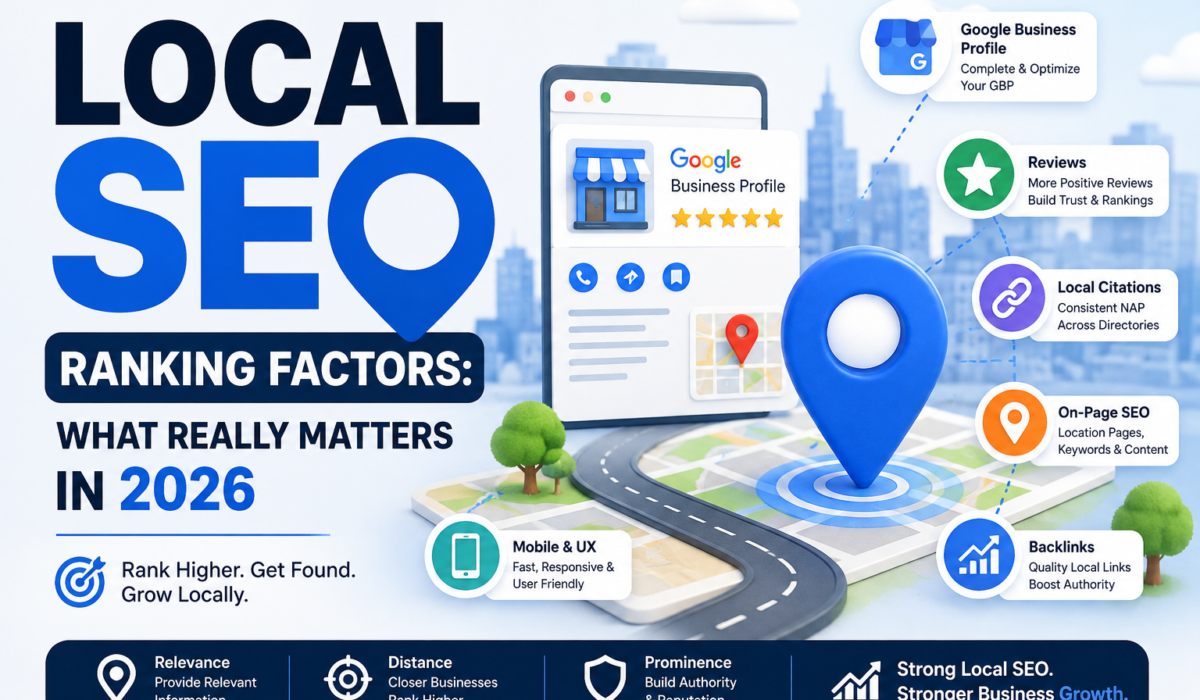
Local SEO Ranking Factors: What Really Matters in 2026
Local SEO helps businesses appear when people search for products and services in a specific area. Whether someone searches for a “dentist near me,” “plumber in Sydney,” or “best podiatrist Brisbane,” Google uses multiple signals to decide which businesses deserve visibility.
But which local SEO ranking factors actually matter in 2026?
Google does not use one simple ranking factor. Local search depends on a combination of relevance, distance, prominence, Google Business Profile information, reviews, website quality, local authority, and other signals. This guide explains the factors that local businesses should prioritise today.
What Are Local SEO Ranking Factors?
Local SEO ranking factors are signals that search engines use to determine which businesses should appear for location-based searches. They help Google understand what a business does, where it operates, how relevant it is to a search, and how prominent or trustworthy it appears. These signals influence visibility across Google Search, Google Maps, and the Local Pack.
How Does Google Rank Local Businesses?
Google evaluates several signals when deciding which local businesses to show. Three core concepts are especially important: relevance, distance, and prominence.
Relevance
Relevance measures how closely a business matches the user’s search. A business offering emergency plumbing services is more relevant to “emergency plumber” than a general home improvement company.
Your business category, services, website content, and Google Business Profile should clearly communicate what you offer.
Distance
Distance refers to how close the business is to the searcher or the location mentioned in the query. This is why local rankings can change from one suburb or neighbourhood to another.
A business may rank strongly for customers nearby but appear lower for someone searching from a different part of the city.
Prominence
Prominence refers to how established and well-known a business appears. Reviews, relevant backlinks, citations, brand mentions, website authority, and local recognition can all contribute to a business’s overall prominence.
The Most Important Local SEO Ranking Factors in 2026
1. Google Business Profile Optimisation
Your Google Business Profile is one of the most important foundations of local SEO. It helps Google understand your business and gives customers essential information directly in search and Maps.
Keep your profile accurate and complete, including:
- Business name
- Primary category
- Secondary categories
- Address or service area
- Phone number
- Website
- Opening hours
- Services
- Business attributes
- Photos
- Reviews
Does Google Business Profile Affect Local SEO?
Yes, your Google Business Profile plays an important role in local search visibility because it provides Google with information about your business, category, location, services, and reputation. A complete and accurate profile makes it easier for Google to understand the business and match it with relevant searches. However, profile optimisation works alongside other local ranking signals.
2. Business Categories
Your primary Google Business Profile category helps Google understand what your business actually is.
For example, a business might be categorised as a Dentist, Podiatrist, Plumber, Locksmith, Restaurant, or Digital Marketing Agency.
Choose the most accurate primary category and only add secondary categories that genuinely describe your services.
Does Business Category Affect Local Rankings?
Yes, business categories are an important relevance signal in local search. The primary category helps Google understand the main type of business you operate, while relevant secondary categories can provide additional context. Choosing unrelated categories simply to target more searches is not a sustainable local SEO strategy.
3. Google Reviews and Reputation
Reviews influence both local visibility and customer decisions. A strong review profile can demonstrate that a business is active, established, and trusted by customers.
Pay attention to:
- Review quality
- Review quantity
- Review recency
- Overall rating
- Customer sentiment
- Professional responses
Encourage genuine customers to leave honest feedback rather than trying to manipulate reviews.
Do Google Reviews Affect Local SEO?
Google reviews are an important part of a local business’s reputation and online presence. They can provide useful information about customer experiences while also influencing whether potential customers choose a business. Reviews should be viewed as part of a wider local SEO strategy rather than a standalone ranking shortcut. Genuine, relevant, and recent customer feedback is the best approach.
4. NAP Consistency and Local Citations
NAP means Name, Address, and Phone Number.
Businesses should keep important information accurate across their website, Google Business Profile, directories, social profiles, and relevant third-party websites.
What Is NAP Consistency?
NAP consistency means keeping a business’s name, address, and phone number accurate across important online sources. Consistent information helps search engines and customers understand that different listings belong to the same business. Businesses should correct meaningful inconsistencies, while avoiding unnecessary concern over harmless formatting differences that do not change the actual information.
What Are Local Citations?
Local citations are online mentions of a business’s information, such as its name, address, phone number, website, or category. They can appear on directories, industry websites, local organisations, and other relevant platforms. Quality matters more than quantity, so businesses should prioritise reputable and relevant citation sources instead of submitting to hundreds of low-quality directories.
5. Local Backlinks
Backlinks can support local authority and prominence, especially when they come from relevant and trustworthy websites.
Useful sources include:
- Local newspapers
- Community organisations
- Industry publications
- Local associations
- Chambers of commerce
- Local events
- Sponsorships
- Business partnerships
Do Backlinks Affect Local SEO?
Relevant backlinks can strengthen a business website’s authority and contribute to local prominence. Links from reputable websites connected to the business’s location, industry, or community can be particularly valuable. Local businesses should focus on earning relevant links naturally rather than buying large quantities of low-quality backlinks.
6. Local Keywords and Search Intent
Local keyword research should reflect how customers actually search.
Common patterns include:
- Service + location
- Service + “near me”
- Problem + location
- Product + location
- Best + service + location
For example:
“Emergency plumber Sydney”
has a different intent from:
“What does a plumber do?”
The first has strong local and commercial intent, while the second is informational.
What Are Local SEO Keywords?
Local SEO keywords are search terms that show geographic intent, often through a city, suburb, neighbourhood, service area, or phrases such as “near me.” They help businesses understand what local customers are searching for and create relevant pages and content. The goal is to satisfy the searcher’s need naturally rather than repeatedly inserting location keywords.
7. Website and On-Page SEO
Your website should reinforce the information in your Google Business Profile.
Important elements include:
- Relevant title tags
- Clear H1 headings
- Service pages
- Location pages
- Internal links
- Localised content
- Contact information
- Helpful FAQs
- Optimised images
- Clear calls to action
A local business website should make it obvious what you do, where you operate, and who you serve.
8. Local Content and Location Pages
Useful local content can strengthen topical relevance and help customers find answers to location-specific questions.
Examples include:
- Local service guides
- Area-specific FAQs
- Customer case studies
- Local buying guides
- Community information
- Service-area pages
- Location-specific advice
Do Location Pages Help Local SEO?
Location pages can help businesses target genuine geographic searches when each page provides useful, unique information about the services available in that area. Simply changing the city name on duplicate pages is not a strong strategy. Every location page should provide genuine value and accurately represent the business’s service coverage.
9. Proximity and Local Prominence
Proximity is especially important for searches such as “near me,” where Google needs to consider the user’s location.
Prominence is broader and relates to how established the business appears across the web and local community.
Relevant backlinks, reviews, citations, brand mentions, local media coverage, and a strong website can all support a business’s overall authority.
Google Maps and Local Pack Ranking Factors
Google Maps and the Local Pack are major opportunities for businesses targeting local customers.
What Are Google Maps Ranking Factors?
Google Maps rankings depend largely on how relevant a business is to the search, how close it is to the relevant location, and how prominent it appears. Google Business Profile information, categories, reviews, website relevance, local authority, and other signals can provide additional context when Google determines which businesses to display.
What Is the Google Local Pack?
The Google Local Pack is the local business section that can appear in search results for location-based queries. It commonly displays businesses alongside a map and information such as ratings, opening hours, categories, and locations. Appearing in the Local Pack can put a business directly in front of customers who are actively looking for a local product or service.
Does Schema Markup Help Local SEO?
Schema markup provides structured information that helps search engines understand a business’s details.
Relevant structured data can include:
- LocalBusiness
- Organization
- PostalAddress
- Service
- GeoCoordinates
- OpeningHoursSpecification
Schema should not be treated as a guaranteed ranking boost. Its main value is helping search engines interpret information accurately and potentially supporting eligible search features.
Does Mobile SEO Matter for Local Businesses?
Yes. Local searches are frequently performed on smartphones, particularly when people need a nearby service or business.
Your website should be:
- Mobile-friendly
- Fast
- Easy to navigate
- Easy to call
- Easy to book
- Easy to find on Maps
- Clear about services and locations
Core Web Vitals, page speed, responsive design, and overall user experience should be part of your technical SEO work.
How Is AI Changing Local SEO in 2026?
AI-powered search is making search queries more conversational. Instead of typing “dentist Sydney,” a user might ask:
“Who is a highly rated dentist near me that offers emergency appointments?”
This means businesses need to provide clear and consistent information about their services, location, expertise, availability, and reputation.
How Does AI Affect Local SEO?
AI-powered search can interpret longer and more conversational queries while combining information from different sources. Local businesses should maintain accurate first-party information, consistent business details, useful content, genuine reviews, authoritative references, and structured data. The goal is to make the business easy for both search engines and AI systems to understand and verify.
What Is AEO for Local SEO?
AEO, or Answer Engine Optimisation, focuses on making information clear and easy for answer-focused search systems to understand. For local businesses, this means answering practical questions about services, locations, pricing where appropriate, opening hours, availability, and customer needs in a direct and useful way.
What Is GEO for Local SEO?
GEO, or Generative Engine Optimisation, focuses on improving how a brand or business is represented in generative AI search experiences. For local businesses, this means building a trustworthy digital footprint across the website, Google Business Profile, reviews, directories, industry websites, local publications, and other reliable sources.
Local SEO Factors That Are Often Overestimated
Not every popular tactic deserves equal attention.
Avoid putting too much emphasis on:
- Keyword stuffing
- Adding city names repeatedly
- Irrelevant Google Business Profile categories
- Hundreds of low-quality citations
- Cheap backlinks
- Duplicate location pages
- Fake reviews
- Social media follower counts
The strongest local SEO strategy is based on relevance, proximity, prominence, reputation, accuracy, and customer value.
How to Improve Local SEO Rankings Step by Step
1. Optimise Your Google Business Profile
Use accurate categories, services, business information, photos, attributes, and opening hours.
2. Build Genuine Reviews
Create a consistent process for asking real customers for honest feedback.
3. Fix Business Information
Audit your NAP and other important business details across major platforms.
4. Optimise Your Website
Improve service pages, location pages, internal linking, content, mobile usability, and technical SEO.
5. Build Local Authority
Earn relevant backlinks, local mentions, partnerships, and media coverage.
6. Create Useful Local Content
Answer real questions and provide genuinely useful information for people in your service areas.
7. Track Results
Monitor Google Search Console, Google Business Profile performance, local rankings, organic traffic, calls, enquiries, bookings, and conversions.
Frequently Asked Questions
What Is the Most Important Local SEO Ranking Factor?
There is no single factor that guarantees a top local ranking. Google evaluates multiple signals, with relevance, distance, and prominence forming the foundation of local search. Business categories, Google Business Profile information, reviews, website relevance, backlinks, citations, and reputation can all contribute depending on the query and searcher’s location.
How Can I Rank Higher on Google Maps?
Start with an accurate and relevant Google Business Profile, choose the correct primary category, maintain strong customer reviews, improve your website, build relevant local authority, and provide useful local content. Remember that proximity also matters, so businesses cannot control every Google Maps result from every location.
Does Domain Authority Matter for Local SEO?
Domain Authority is a third-party SEO metric, not a Google ranking score. A strong website and relevant backlinks can still support local visibility and prominence. Instead of chasing a specific Domain Authority number, focus on earning trustworthy links, publishing useful content, building local relevance, and creating a credible online presence.
Does Local SEO Still Matter in 2026?
Yes. Local SEO remains important for businesses that depend on customers in specific geographic areas. Searchers continue to use Google Search and Maps to discover businesses, compare reviews, check services, and make decisions. AI-powered search is changing how information is presented, but accurate business information, relevance, reputation, and local authority remain important.
Final Takeaway
The best local SEO strategy in 2026 is not about finding one secret ranking factor.
It is about building a business presence that Google and customers can easily understand and trust.
Focus on:
- Google Business Profile optimisation
- Accurate business categories
- Relevance and search intent
- Proximity
- Reviews and reputation
- NAP consistency
- Quality citations
- Relevant local backlinks
- Useful local content
- Strong service and location pages
- Mobile-friendly website
- Technical SEO
- Structured data
- Local authority
- AI and conversational search readiness
When these elements work together, your business has a much stronger foundation for visibility in Google Search, Google Maps, the Local Pack, and emerging AI-powered search experiences.